


Some food, some drink.
The Pinnacle of Turkey Leftovers: Slow Cooker Turkey Stock.


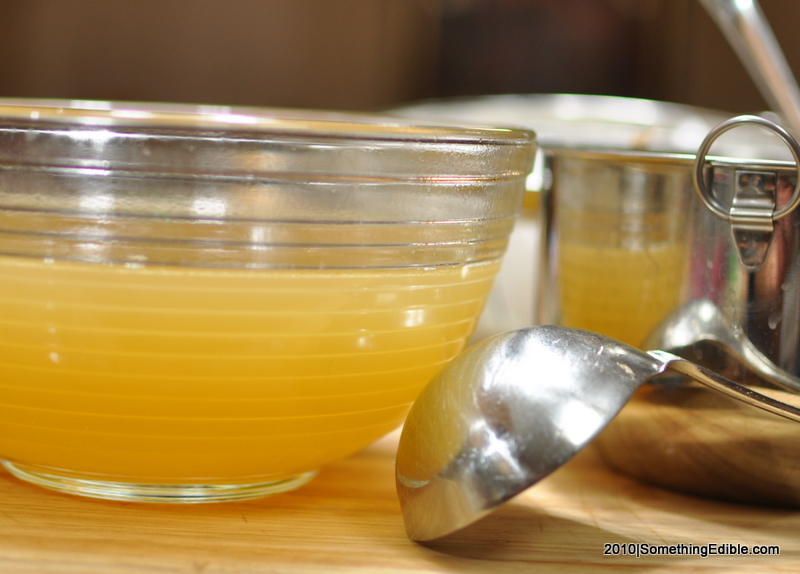
Abstract:
Shame on the person that goes to all the trouble to roast a turkey, only to throw out the bones when the eating is over. There's all kinds of potential flavor and lip-smacking goodness waiting to be released from that shell of a bird, and making stock is the way to do it. Making stock from what's left of a roast turkey isn't hard; but using a slow cooker (aka Cock Pot) makes the process downright mindless. With huge flavor payoffs for so very little work, the best thing you can do with your turkey is likely to occur when the main meal's all but a memory.
Purpose:
If you're the visual type, then you'll want to check out this companion video for this slow cooker stock recipe. And don't forget to subscribe to my YouTube Channel for my latest recipe videos!
I get a bit crazy about roast turkey. My minor obsession with the holiday bird is probably something akin to Ralphie's Dad; I gotta get my fix. And as much as I can't get enough of the main event, what really gets me excited about roasting a turkey is the stock that I'll be taking from that carcass when the eating's done. You've spent enough time making that kick-ass meal the day before, and creation of a stock doesn't need to be an event in and of itself. Besides a bit of cheesecloth, a large slow-cooker is the only special equipment necessary to create a stock that re-captures the essence of Turkey-Day.
Incidentally, is there anyone else besides my wife that loathes the cacophony of the word "carcass"? I happen to think that it does the animal a bit more respect than words like "scraps" or "remains" (ewwww), so that's what I'm sticking with. Let's just get the unfamiliarity out of the word right now so I can use it and you won't be distracted:
Carcass, carcass, carcass.
Carcass, carcass, carcass.
Now, lets have a look at the stock -
Recipe: Jump to the detailed recipe. (or, keep reading for the gist of it) -
Special Equipment
Add the turkey carcass and water to the slow cooker. Set your Crock Pot to low, cover and let it go for 6 hours. Add onion, carrots, and celery and continue cooking on low for 2 more hours. At the end of the slow cook, remove all the large bits with a slotted spoon and discard (or, give to the dog- but not the onion or the bones; that isn't good for 'em). Strain liquid thru two layers of cheesecloth and allow to come to room temperature. Refrigerate overnight and skim off any unwanted fat and/or gunk that floated to the top. Keep refrigerated and use within a couple of days, or portion out appropriately to freeze.
Observation:
- I really can't recommend that you do this process on your Cock Pot's "high" setting to try to save time. The idea is not to use heat to create flavor, but rather to extract proteins and flavor compounds that are already present from prior cooking. Trust me here, patience pays.
- The veggies are added closer to the end so as to draw out those fresh flavors and add a bit of brightness to the stock. Longer cooking times will only serve to muddy the flavors and defeats the purpose of adding those aromatics all together.
- If you haven't already tossed them from the prior day's events, use the veggie parts you weren't going to eat. Middles of celery and ends of large carrots are great for stocks.
- Keep in mind when it's time to strain that you started with about 2 quarts of liquid. Choose your containment vessel accordingly. That said, a significant amount of liquid will be retained by the stuff you're gonna throw away, and you'll lose some to evaporation. Don't expect the amount of finished product to be equivalent.
- When skimming the stock, don't get bent out of shape if you don't recover a lot of fat from the top. The swell thing about roasting turkey is that the majority of the fat renders out during the roast. You'll probably get more crud (<- technical term) than fat.
- When it's time to portion out the stock, a minute or so in the microwave will make things much more pourable. Just don't go cookin' it any more than necessary.
- When it's time to freeze stock, I like to lay my filled zip-top bags flat on a cookie sheet in the freezer. It makes them much easier to store, and they thaw faster when I need them.
- When you're ready to thaw your stock, I'd recommend putting the bag in a dish or something in the off-chance that all that banging around in the deep freeze put an undetectable hole in the bag.
Results:
The biggest reason that stock is superior to broth for so many things is the wonderful mouth feel that one gets from the collagen extracted from the connective tissue in the carcass. In the presence of gentle heat and some water, that previously inedible stuff transforms into gelatin, which does a much better job of carrying flavors than plain ol' water. Whereas broth is akin to a string ensemble, a stock is the whole damn orchestra. It doesn't bother me in the slightest that stock isn't salty; it doesn't need to be. Where flavor is concerned, salt can be added with minimal penalty at almost any point in cooking. And while most recipes will state that stock and broth share a bit of interchangeability, you can always taste the love and umami that goes into a stock.
So, now that you've made some totally decent stock, the next question is what the hell to do with it? I think the better question is, "What can't you do with it?" I guess it goes without saying that stock has the potential to make all souply applications a legendary experience, but there are also other uses that are traditionally under-utilized by most folks. Try subbing out the H2O with some stock the next time you make rice, legumes or barley. Using stock is a given for risotto, so it goes to figure that it'd be ok in less tedious dishes. Likewise, if you're making dressing/stuffing, using stock is a must.
I freeze my stock up in one pound/pint proportions, and anytime I'm looking to add oomph to an otherwise monochromatically-flavored dish, I run to the freezer. Turkey stock plays as nicely in pork and beef applications as it does with poultry. Adding stock to a recipe is a great way to enhance flavor and make those meaty flavors taste more like themselves. Good stock serves the same purpose as msg, but in a good, natural way (without all that migraine-inducing, chemical-receptor-fooling business). Turkey stock (or any other stock for that matter) has the potential to make a good recipe spectacular; so unless you just really appreciate mediocre food, there's absolutely no reason to give that Crock Pot a post-holiday workout.
Gallery:
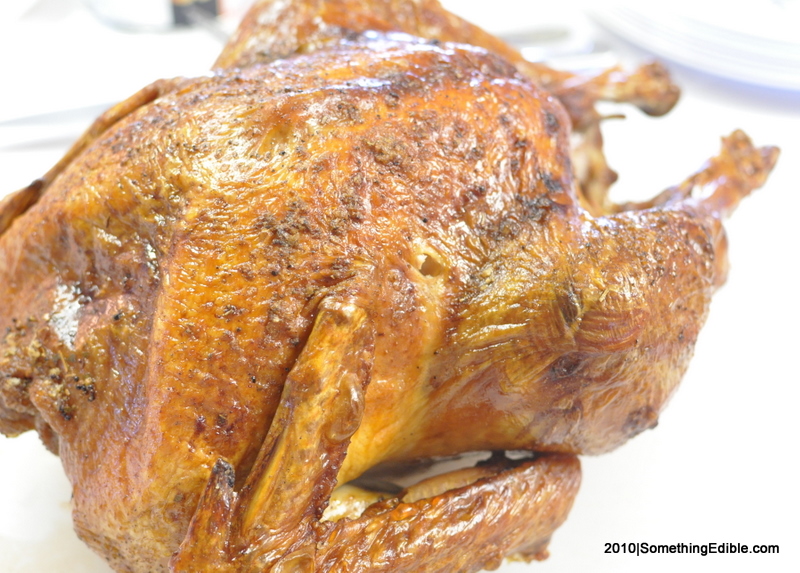
Here's the bird, right before carving on Thanksgiving day. Better things await those bones than the trash.
Here's the bird, right before carving on Thanksgiving day. Better things await those bones than the trash.
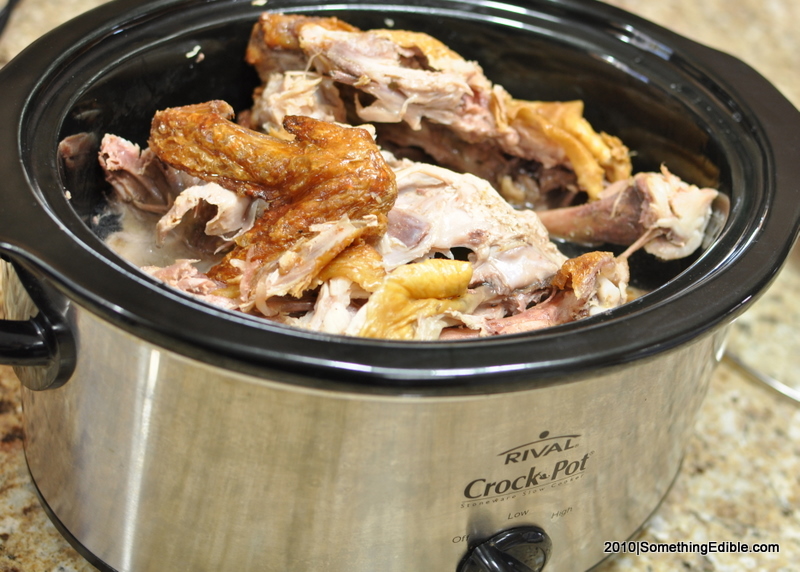
I know this ain't pretty, but I figured y'all would like to know just how full a 4.5 qt Crock Pot looked with the carcass in there.
I know this ain't pretty, but I figured y'all would like to know just how full a 4.5 qt Crock Pot looked with the carcass in there.

Please resist the temptation to add any additional NaCl. Treat your stock as a base ingredient; just like salt. No need to cross the streams just yet.
Please resist the temptation to add any additional NaCl. Treat your stock as a base ingredient; just like salt. No need to cross the streams just yet.

With all those wonderful smells that'll be wafting thru your house all day, you'd better get used to a familiar at your heels.
With all those wonderful smells that'll be wafting thru your house all day, you'd better get used to a familiar at your heels.
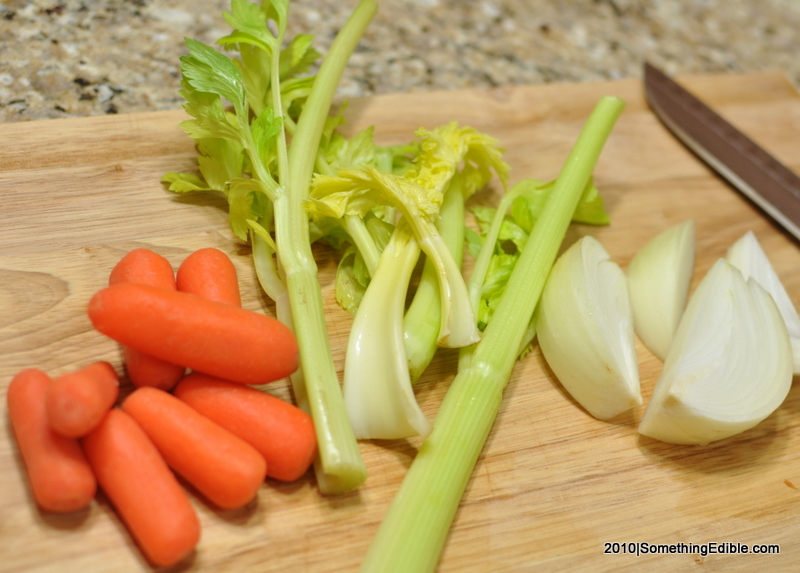
The aromatics are ready to be added to the stock. I didn't have any large carrots, so I pilfered some from yesterday's crudites tray.
The aromatics are ready to be added to the stock. I didn't have any large carrots, so I pilfered some from yesterday's crudites tray.
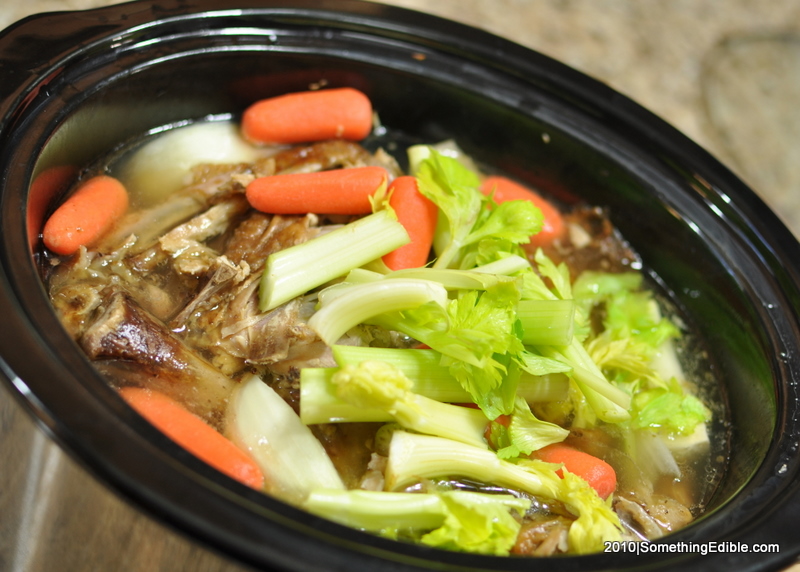
After the six-hour hot soak, the turkey carcass gets a little company. I'm already thinking about all the good stuff I'll be cooking with my soon-to-be…
After the six-hour hot soak, the turkey carcass gets a little company. I'm already thinking about all the good stuff I'll be cooking with my soon-to-be stock.
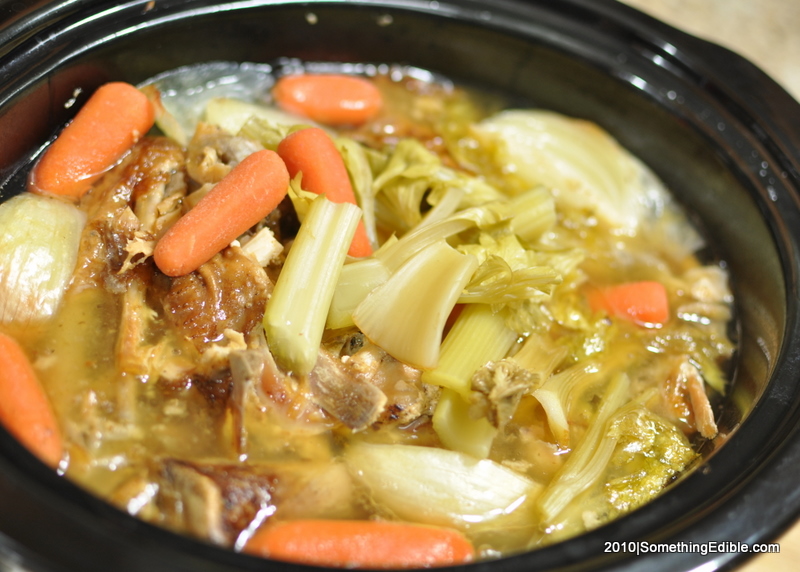
The cooking is all done. Notice that the veggies are still recognizable (albeit now tasteless).
The cooking is all done. Notice that the veggies are still recognizable (albeit now tasteless).
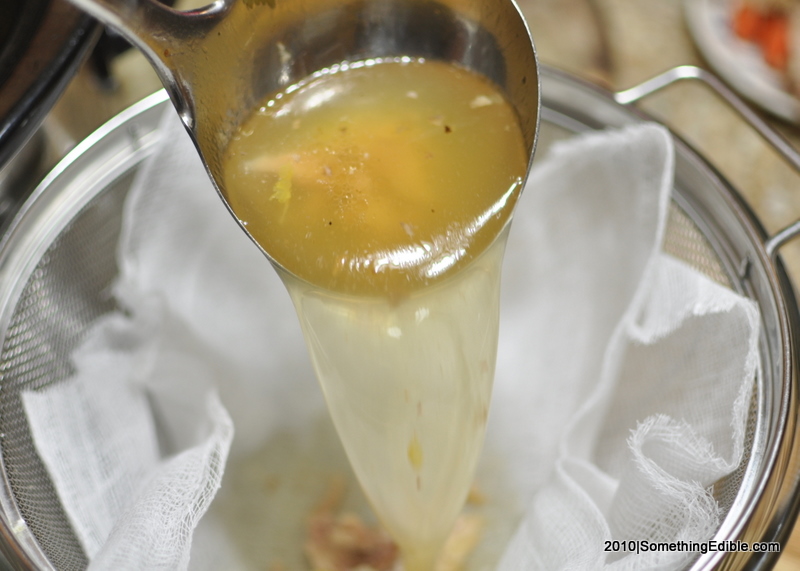
After foraging out the big chunks, the stock can be filtered thru a couple layers of cheesecloth and into a large vessel to cool.
After foraging out the big chunks, the stock can be filtered thru a couple layers of cheesecloth and into a large vessel to cool.
The stock is now filtered and ready for a cool-down. You could use it now, but an overnight chill ensures that anything undesirable separates from the…
The stock is now filtered and ready for a cool-down. You could use it now, but an overnight chill ensures that anything undesirable separates from the stock.
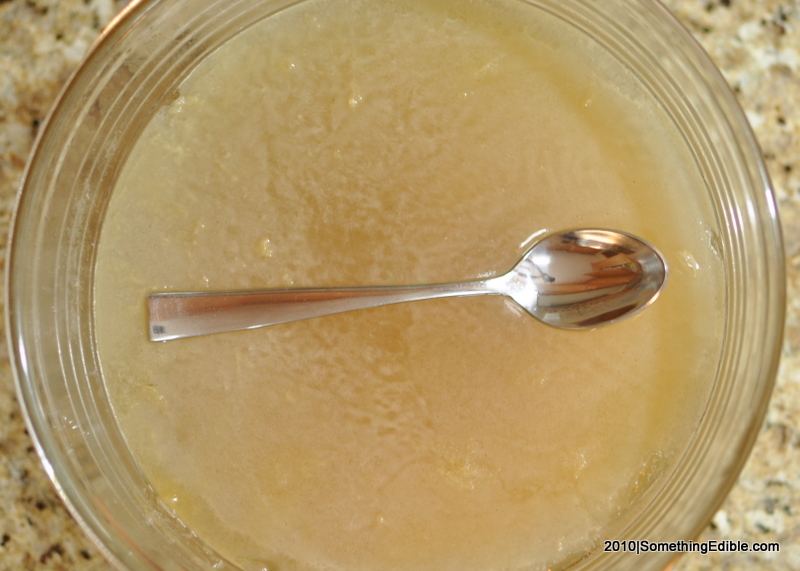
If your chilled stock can support the weight of a spoon, you're doing it right.
If your chilled stock can support the weight of a spoon, you're doing it right.
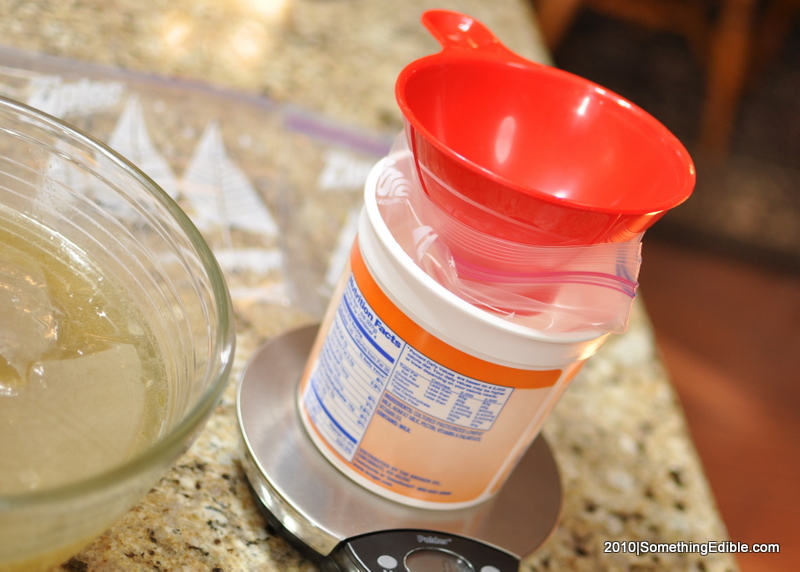
It's easier to weigh stock into plastic bags than it is to portion by volume. Just keep ladling until you reach your desired amount.
It's easier to weigh stock into plastic bags than it is to portion by volume. Just keep ladling until you reach your desired amount.
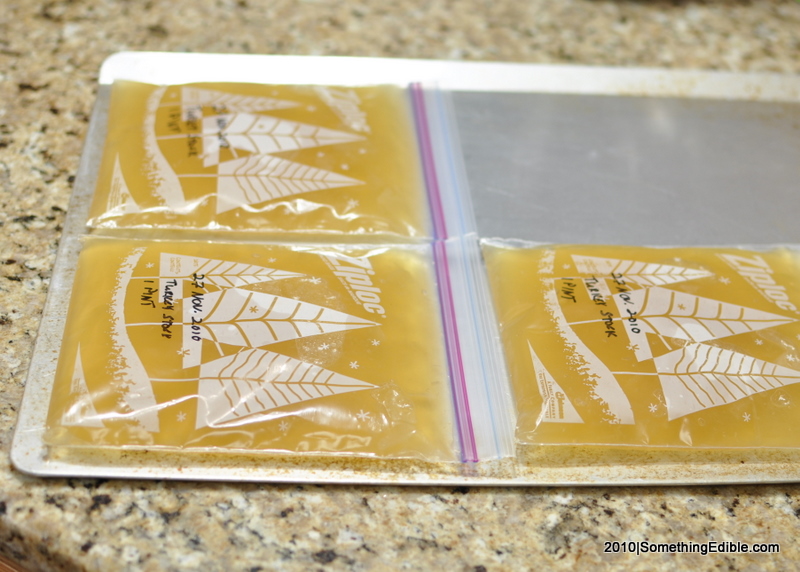
I find that laying my pints of stock on a cookie sheet to freeze makes them easier to store. It also means they'll thaw faster when I need them, as I've…
I find that laying my pints of stock on a cookie sheet to freeze makes them easier to store. It also means they'll thaw faster when I need them, as I've maximized surface area.
Get Social
Please wait while my tweets load...
Get the latest recipes and news. Join our Facebook page!


